+ 852-30184902
 + 65-31581460
 + 44-2074425848
 + 30-2103007223
 + 1-6465830707
 + 91-8050415206
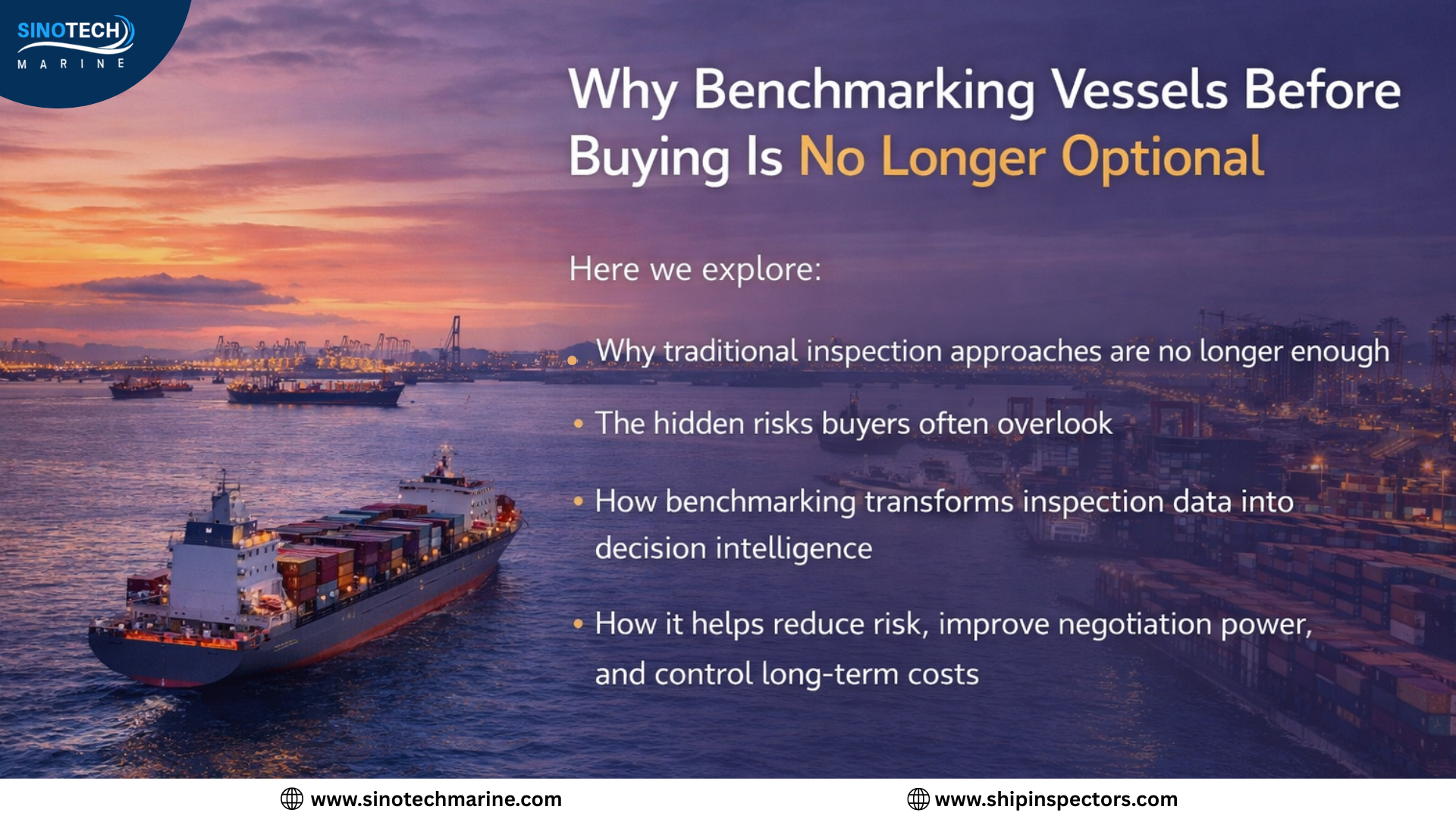
Structured benchmarking approach helps buyers reduce uncertainty, control risk, and make confident acquisition decisions.
Vessel Acquisition in a High-Risk Environment
Purchasing a second-hand vessel has always been a capital-intensive decision, but today’s maritime landscape has amplified the complexity. Asset values fluctuate rapidly, regulatory requirements evolve continuously, and operational costs leave little room for miscalculation.
In this environment, buyers can no longer rely solely on traditional inspection outcomes.
An inspection may confirm a vessel’s technical condition, yet it does not automatically answer the most critical investment question:
How does this vessel compare to other industry vessels?
This is precisely where vessel benchmarking becomes indispensable.
At Sinotech Marine, benchmarking is treated not as an optional analytical layer, but as a fundamental component of a smarter vessel acquisition approach.
The Limitations of Standalone Vessel Inspections
A conventional vessel inspection primarily focuses on identifying technical deficiencies, structural damages, maintenance gaps, and regulatory compliance issues. This type of inspection is essential for assessing the vessel’s immediate condition, it typically evaluates the ship in isolation.
However, vessel acquisition decisions are rarely made in isolation.
In real-world transactions, buyers often assess multiple candidate vessels within the same vessel class, age group, and trading segment. Relying solely on a standalone inspection can create critical gaps in the decision-making process.
Common limitations of traditional inspection-based assessments include:
- Dependence on individual inspector judgment, influenced by personal experience and technical interpretation
- Lack of condition-adjusted valuation insights to understand the vessel’s true market positioning
- Absence of structured benchmarking against industry standards and peer vessels
- Limited negotiation leverage during purchase discussions due to insufficient comparative intelligence
- No comparative analysis against vessels of similar type, age, and operational profile
- Unclear condition-based investment decisions, particularly when evaluating multiple acquisition candidates
As a result, a vessel may successfully pass a standalone inspection, yet still represent a weaker investment when compared to similar vessels available in the market.
Without structured benchmarking and comparative analysis, buyers may struggle to fully understand how the vessel truly ranks within its competitive peer group, potentially exposing them to hidden financial, operational, and lifecycle risks.
🔎 Read More: How Verified Inspectors Build Trust in Vessel Inspections
Before benchmarking delivers value, the quality and reliability of inspection data is critical.
At Sinotech Marine, our network of verified marine inspectors ensures that every inspection is conducted with consistency, transparency, and technical accuracy. Building the foundation for trustworthy benchmarking insights.
👉 Read our detailed blog on:
How Sinotech Verified Inspectors Gain Customer Trust
How Sinotech Marine Benchmarking Supports Smarter Decisions
A vessel may appear to be in excellent condition during a standard inspection, yet it can still carry hidden risks that affect its long-term value. When buyers rely only on a standalone inspection or the opinion of a single inspector, an important question often remains unanswered:
How does this vessel truly compare with similar vessels in the market?
This is where Sinotech Marine S&P Benchmarking adds real value.
Instead of evaluating a vessel in isolation, our structured benchmarking approach compares the vessel with a relevant peer group of ships with similar type, age, and operational profile. This comparative analysis provides deeper insight into the vessel’s relative condition, risk exposure, and long-term performance potential.
By combining inspection findings with data-driven benchmarking intelligence, buyers gain a clearer and more reliable foundation for making vessel acquisition decisions.
Key Benefits of Sinotech S&P Benchmarking
Clearer Decision Making
Benchmarking helps buyers understand how the vessel performs compared to similar ships in the market, enabling more informed acquisition decisions.
Lower Investment Risk
Comparative analysis helps identify technical weaknesses, maintenance exposure, or operational concerns that may not be immediately visible during a standard inspection.
Stronger Negotiation Position
With structured benchmarking data, buyers can support price discussions with objective market comparisons and stronger commercial leverage.
Reduced Compliance Risk
Benchmarking highlights areas where a vessel may fall behind regulatory or industry standards, helping buyers anticipate future compliance requirements.
Lower Long-Term Operational Costs
By identifying vessels with higher-than-average maintenance exposure, buyers can avoid assets that may generate excessive lifecycle costs.
Inspection Shows Condition — Benchmarking Shows Market Position
A vessel inspection reveals the current condition of the ship.
Benchmarking reveals how that vessel actually performs relative to others in the market.
Together, they create the level of insight required to make confident and responsible vessel acquisition decisions.
Conclusion – From Condition Assessment to Decision Intelligence
In today’s maritime environment, inspections alone are not enough.
Benchmarking provides the contextual intelligence required to transform technical findings into confident acquisition decisions.
At Sinotech Marine, benchmarking is integrated into the inspection philosophy to ensure stakeholders operate with clarity, consistency, and risk-aware insight.
When vessels are benchmarked, decisions are sharper.
When decisions are sharper, investments are stronger.
Explore Vessel Benchmarking with Sinotech Marine
Strengthen your vessel acquisition decisions through structured comparative analysis.
📩 Have a vessel evaluation requirement?
enquiries@sinotechmarine.com